You are evaluating a physician practice roll-up, a dental platform, or a behavioral health consolidation play. The fragmentation looks attractive: thousands of independent operators, aging founders ready to exit, and recurring revenue from insured patients. But somewhere between the CIM and confirmatory diligence, the thesis starts to wobble. Reimbursement rates shift. A state licensing board changes its rules on corporate practice. Staffing costs spike. The platform economics that worked in one MSA collapse in another.
Healthcare private equity sits at the intersection of genuine structural opportunity and concentrated regulatory, reimbursement, and operational risk. For SME operators exploring this sector, whether as potential targets, platform builders, or service providers to PE-backed healthcare businesses, understanding where consolidation creates durable value versus where it creates fragile, policy-dependent returns is the difference between a successful thesis and a write-down.
This study examines healthcare services private equity from an operator's perspective: what makes the sector attractive and hazardous simultaneously, which subsectors support durable consolidation, and what separates platforms that compound value from those that stall when the regulatory or reimbursement environment shifts.
Why Healthcare Services Attract and Punish Capital Simultaneously
The investment thesis for healthcare consolidation rests on a few structural realities. Healthcare spending in the United States exceeded $4.5 trillion in 2022, according to the Centers for Medicare and Medicaid Services, and continues growing faster than GDP. Demand is largely non-discretionary. Payment often comes from third parties with deep pockets. And fragmentation across most care delivery subsectors creates a target-rich environment for buy-and-build strategies.
The hazards are equally structural. Reimbursement is set by payers, not providers, meaning pricing power is constrained. Regulatory frameworks vary by state, service type, and corporate structure. Labor markets for clinical staff remain persistently tight. And political exposure runs high: healthcare consolidation attracts scrutiny from the FTC, state attorneys general, and increasingly from Congress.
Bain & Company's 2024 healthcare private equity report noted that while healthcare deal value has declined from its 2021 peak, the sector still represented roughly 20% of total PE deal activity by count. The opportunity remains large. The execution risk is what separates successful platforms from troubled ones.
The Fragmentation Paradox
Fragmentation creates acquisition opportunity but also signals something about the underlying economics. Markets that remain fragmented despite decades of consolidation pressure often have structural barriers: regulatory constraints on corporate ownership, local relationship dependencies, or economics that do not improve meaningfully at scale. Understanding why a subsector stayed fragmented matters as much as recognizing that it is.
Mapping Target Density Across Healthcare Subsectors
Not all healthcare services fragmentation is equal. Some subsectors have thousands of independent operators with similar service models, making roll-up execution straightforward. Others have fragmentation driven by specialization, geography, or regulatory carve-outs that resist platform aggregation.
Understanding market fragmentation in healthcare requires looking at several dimensions: number of independent operators, average practice size, founder age and succession planning, and the degree to which services are standardized versus relationship-dependent.
High-Density Subsectors
Dental practices represent one of the most consolidated subsectors, with DSOs (dental service organizations) now supporting roughly 10% of practicing dentists according to the American Dental Association Health Policy Institute. The thesis here is mature but not exhausted.
Behavioral health has seen rapid consolidation, driven by parity legislation, destigmatization, and employer focus on mental health benefits. Applied behavior analysis (ABA) for autism services became a particularly active subsector, though reimbursement and staffing challenges have emerged.
Physician practices in specialties like dermatology, ophthalmology, and gastroenterology have attracted significant capital. These tend to have procedure-based revenue, ancillary income opportunities, and relatively standardized care delivery.
Lower-Density or Structurally Resistant Subsectors
Primary care remains challenging for pure-play roll-ups. Margins are thin, visit volume is high, and value-based care arrangements require capabilities most small platforms lack. Successful primary care consolidation tends to involve payer partnerships or risk-bearing arrangements, not just practice aggregation.
Home health and hospice have regulatory complexity around Medicare certification, state licensure, and referral relationships that create geographic pockets rather than national scalability.
Reimbursement, Payer Mix, and Regulatory Exposure as Swing Factors
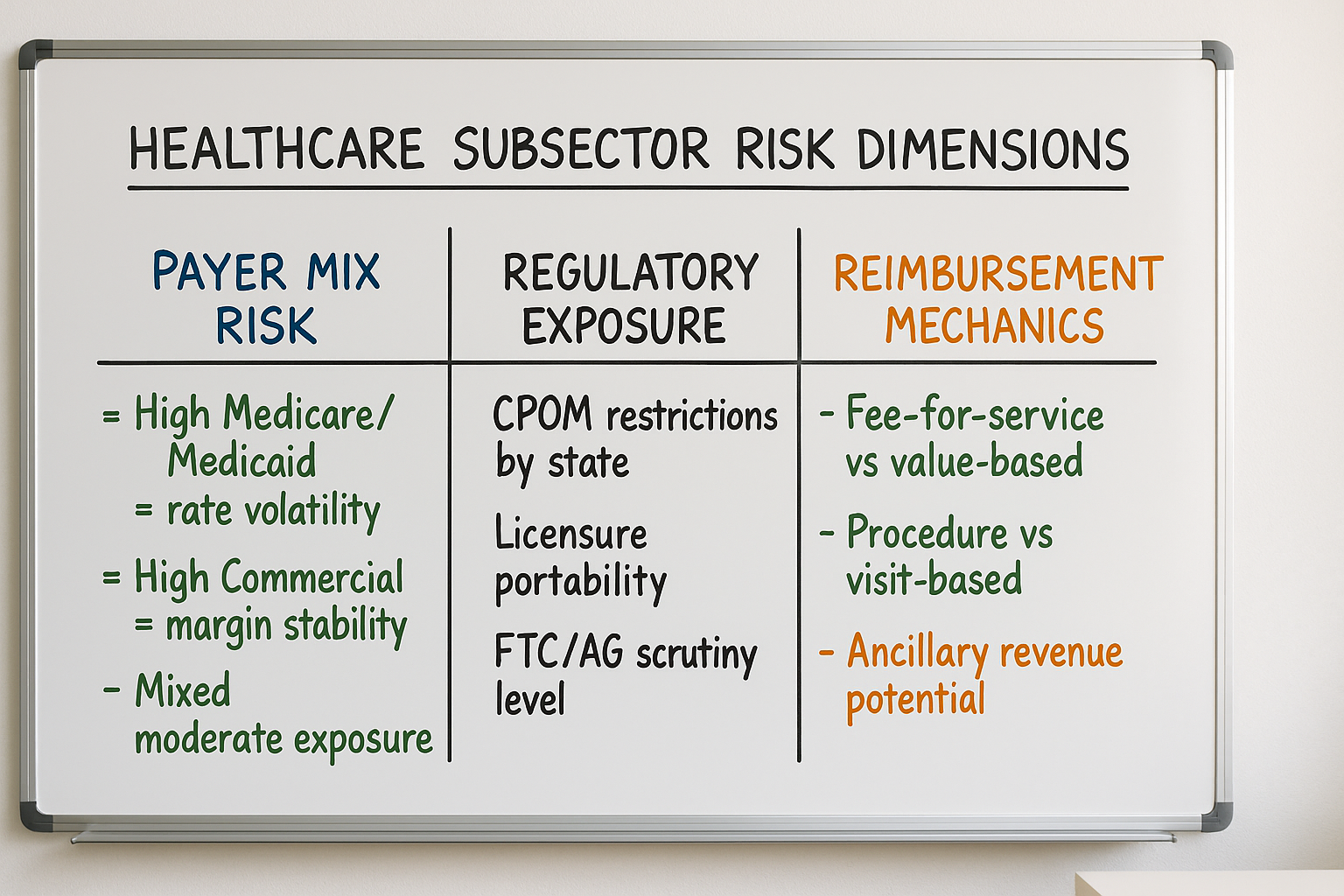
Reimbursement is the single largest source of thesis risk in healthcare private equity. Unlike most B2B or consumer services, healthcare providers largely accept prices set by third parties. A change in Medicare reimbursement rates, a state Medicaid program decision, or a shift in commercial payer contracting can move margins by hundreds of basis points.
Payer Mix as a Risk Profile
Practices with high commercial payer concentration generally have better margins and more pricing stability. Those dependent on Medicare or Medicaid face both rate risk and administrative burden risk. The No Surprises Act, prior authorization requirements, and claims denial rates all affect cash collection and working capital.
McKinsey's healthcare practice has noted that commercial payer margins can be 2-3x Medicare margins for the same procedure in many specialties. A platform with 70% commercial payer mix has a fundamentally different risk profile than one with 50% Medicare exposure.
Regulatory Exposure Beyond Reimbursement
State-level corporate practice of medicine (CPOM) laws determine whether a PE-backed entity can directly own a medical practice or must use an MSO structure. These laws vary significantly. California, Texas, and New York have restrictive CPOM frameworks. Other states are more permissive.
The regulatory environment is not static. State attorneys general have begun scrutinizing healthcare consolidation more aggressively. The FTC has challenged hospital and health system mergers and is increasingly interested in physician practice consolidation. A thesis that depends on continued acquisition activity faces regulatory uncertainty that may not have existed when the platform was formed.
Platform Economics: MSO Structures, Referral Density, and Staffing
The operational model for most healthcare private equity platforms centers on the Management Services Organization (MSO). The MSO provides administrative, billing, compliance, and operational services to affiliated practices while the practices retain clinical independence and, in CPOM states, legal ownership of the medical practice.
This structure creates value when the MSO genuinely improves practice operations. It creates fragility when the MSO relationship is primarily a financial engineering exercise without operational substance.
What the MSO Must Actually Do
Effective MSOs provide revenue cycle management that improves collections, procurement that reduces supply costs, HR infrastructure that addresses clinical staffing, compliance systems that manage regulatory requirements, and data analytics that support clinical and operational decisions. The administrative burden on small practices is real, and relief from that burden is a genuine value proposition.
Where MSOs struggle is when the platform grows faster than operational capability. Adding practices faster than the MSO can integrate them creates administrative chaos, physician dissatisfaction, and margin compression rather than expansion.
Referral Density and Geographic Strategy
Healthcare services are inherently local. Patients generally seek care within a reasonable drive time. Referral relationships between primary care, specialists, and facilities develop over years. A platform strategy that emphasizes geographic density, building clusters of practices in specific MSAs, can create referral network effects and operational efficiencies that scattered national footprints cannot.
Understanding industry consolidation patterns in healthcare requires this geographic lens. National scale matters less than regional density in most care delivery subsectors.
The Staffing Constraint
Clinical staffing is the binding constraint on growth for most healthcare platforms. According to the Association of American Medical Colleges, the United States faces a projected shortage of between 37,800 and 124,000 physicians by 2034. Nurses, medical assistants, and specialized clinical staff face similar supply constraints.
A buy-and-build strategy that assumes staff can be hired to fill new capacity often underestimates this constraint. Platforms that retain acquired physicians and staff, and that build cultures attractive to clinical talent, outperform those that treat staffing as a procurement problem.
Signals of a Durable Versus a Policy-Fragile Roll-Up
Some healthcare platforms will compound value through multiple ownership cycles. Others will struggle when reimbursement changes, regulatory scrutiny intensifies, or labor markets tighten further. Distinguishing between them requires looking at specific structural features.
Indicators of Durability
Diversified payer mix with limited concentration in any single payer or government program reduces reimbursement volatility.
Geographic density in core markets creates referral networks, operational efficiency, and recruiting advantages that scattered footprints lack.
Physician alignment through meaningful equity participation, clinical governance roles, and practice autonomy on clinical decisions. Platforms where physicians feel like employees of a distant corporate owner face retention and quality risks.
Operational substance in the MSO demonstrated through documented improvements in collections, staffing retention, compliance performance, and physician satisfaction.
Modest leverage relative to cash flow stability. Healthcare platforms with high debt loads and thin coverage ratios have limited room to absorb reimbursement shocks.
Warning Signs of Fragility
Heavy Medicare or Medicaid dependence without value-based care capabilities creates pure rate exposure.
Rapid acquisition pace without corresponding integration infrastructure suggests operational debt accumulating faster than synergies realize.
Physician departures post-acquisition, particularly of high-producing or clinically respected providers.
Single-state concentration in states with active regulatory scrutiny or historically aggressive AG offices.
Thesis dependent on continued multiple arbitrage rather than operational value creation.
The Countercase: Where Healthcare Consolidation Stalls or Reverses
Not every healthcare subsector supports consolidation, and some that appeared attractive have proven challenging. Understanding where roll-ups stall provides important perspective for evaluating new opportunities.
Urgent Care: A Cautionary Example
Urgent care saw significant PE investment in the 2010s based on a thesis of convenience, cash-pay opportunity, and facility-light operations. The reality proved more complex. Competition from retail health clinics, employer on-site clinics, and eventually telehealth pressured volumes. Real estate costs remained sticky. And differentiation between urgent care operators proved difficult to establish.
Several large urgent care platforms have struggled or been restructured. The subsector is not unviable, but the original consolidation thesis required revision.
ABA Therapy: Reimbursement and Staffing Stress
Applied behavior analysis for autism services grew rapidly as states mandated coverage. PE capital flowed in. But reimbursement rates have compressed in several states, RBT (registered behavior technician) staffing has proven extremely challenging, and some platforms have faced quality concerns that attracted regulatory attention.
The underlying demand remains strong. The economics of delivering the service at scale have proven more difficult than early platform builders anticipated.
Primary Care Roll-Ups Without Risk Contracts
Pure fee-for-service primary care consolidation has largely disappointed. Margins are thin, competition from health systems is intense, and the administrative savings from consolidation do not offset the slim per-visit economics. Successful primary care platforms have generally moved toward value-based care arrangements, Medicare Advantage contracting, or employer direct contracting, models that change the fundamental economics.
Value-Creation Levers Specific to Care-Adjacent Businesses
Healthcare private equity extends beyond direct care delivery into care-adjacent services: revenue cycle management, healthcare IT, medical devices, clinical staffing, and other services that support care delivery without directly providing it.
For SME operators in care-adjacent businesses, understanding the value-creation playbook that PE applies can inform both positioning as an acquisition target and strategy as an independent operator.
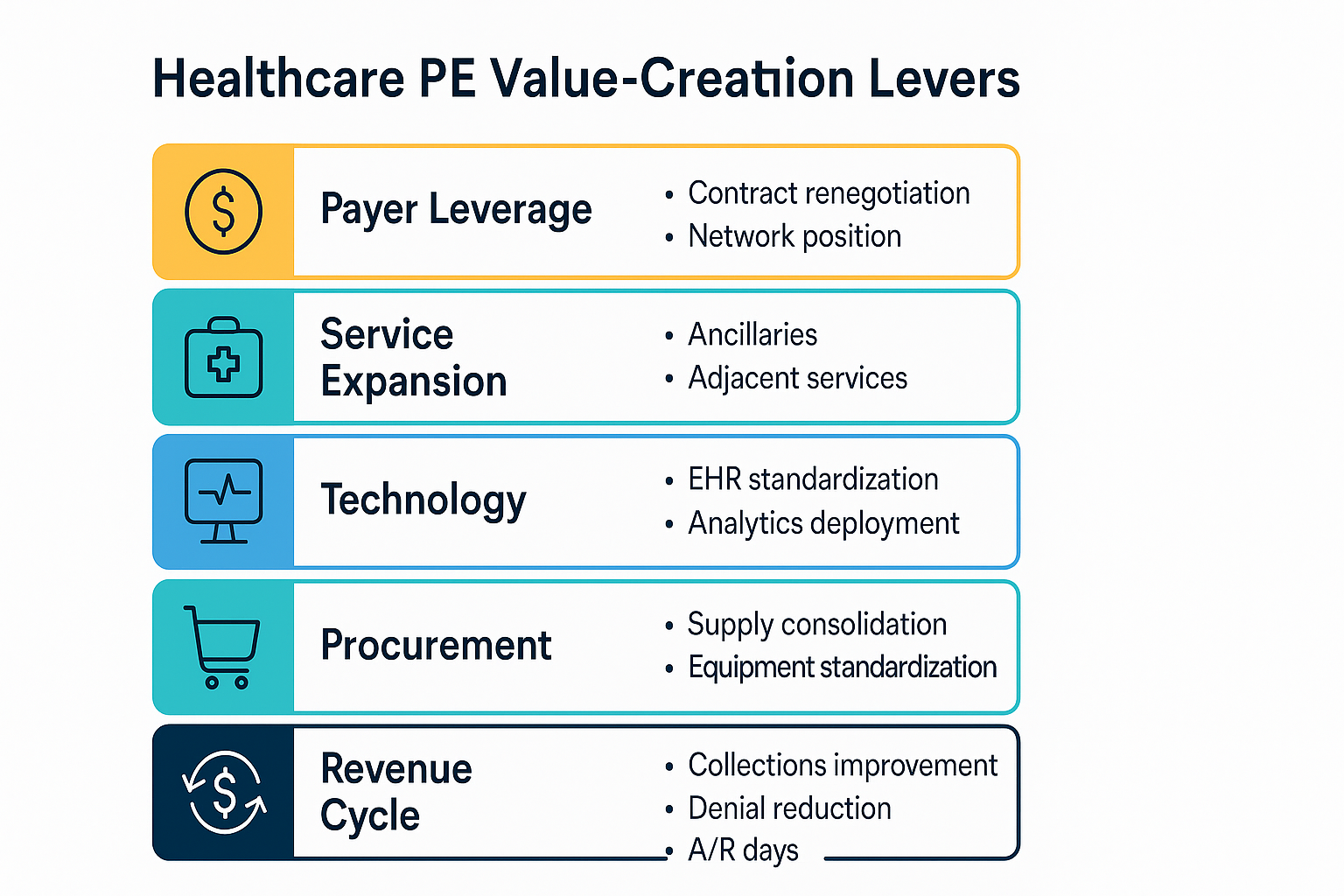
Common Value-Creation Levers
Revenue cycle optimization across acquired entities, standardizing billing practices, reducing days in A/R, and improving denial management.
Procurement consolidation for supplies, equipment, and services where scale creates genuine purchasing leverage.
Technology enablement through standardized EHR platforms, practice management systems, and data analytics.
Service line expansion adding ancillary services (imaging, lab, pharmacy where permitted) that capture revenue currently referred out.
Payer contracting leverage where geographic density and patient volume create negotiating position with commercial payers.
A well-structured private equity roll-up strategy in healthcare focuses on these operational levers rather than relying primarily on multiple expansion through scale alone.
Healthcare-Subsector Consolidation Scorecard
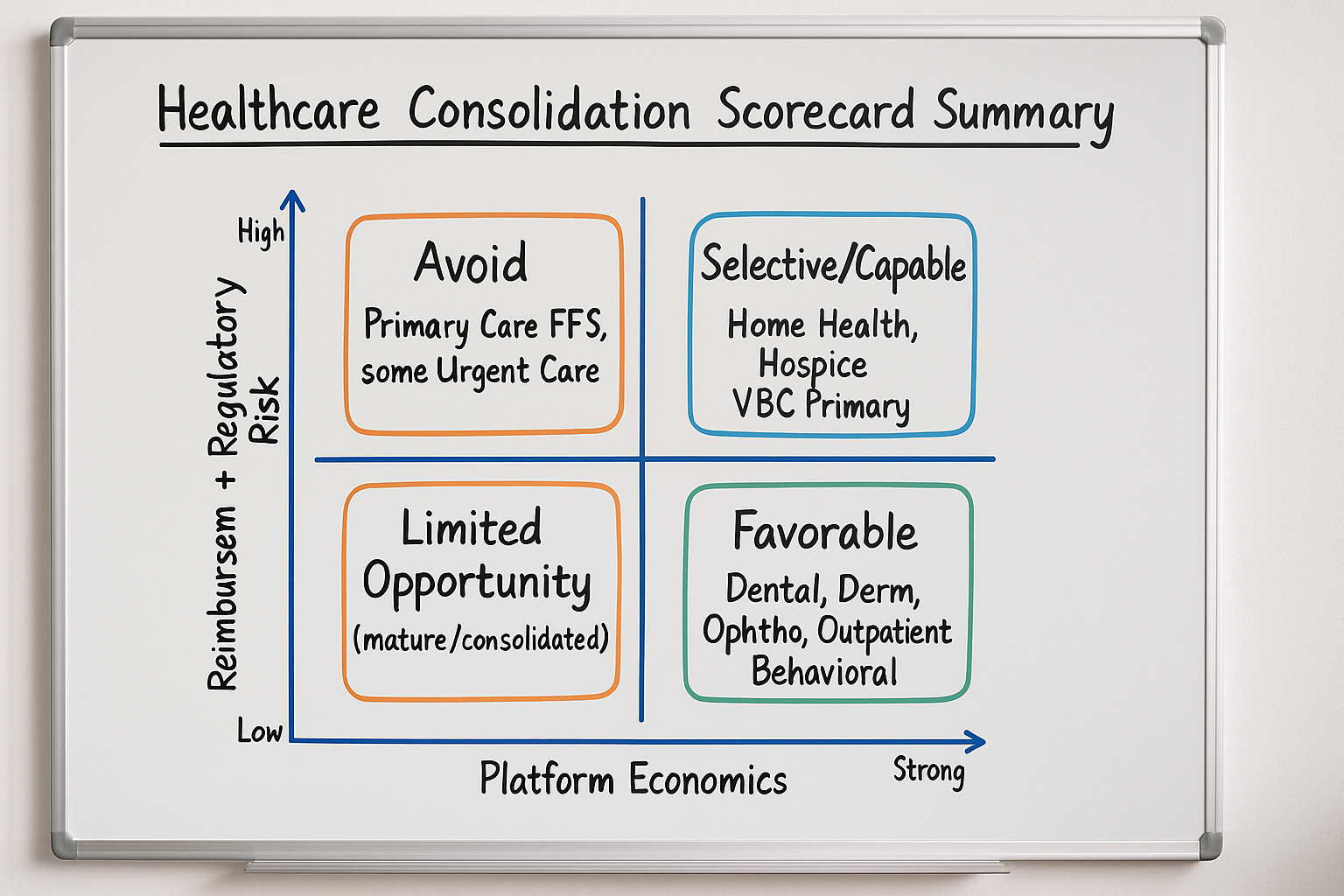
The following scorecard provides a framework for evaluating consolidation potential across healthcare services subsectors. This is not a definitive assessment but a structured approach to the key dimensions that determine whether a subsector supports durable platform building.
| Subsector | Fragmentation Level | Reimbursement Risk | Regulatory Exposure | Platform Economics | Overall Consolidation Potential |
|---|---|---|---|---|---|
| Dental (DSO) | High, ~90% independent | Moderate, commercial-heavy mix | Low-Moderate, limited CPOM issues | Strong, proven MSO model | Favorable, maturing |
| Dermatology | High, small practice dominant | Moderate, procedure mix helps | Moderate, CPOM varies by state | Strong, ancillary opportunity | Favorable |
| Ophthalmology | Moderate-High | Moderate, Medicare exposure in cataract | Moderate, ASC regulations | Strong, surgical ancillaries | Favorable with payer monitoring |
| Behavioral Health (Outpatient) | Very High, highly fragmented | Moderate-High, parity enforcement variable | Moderate, licensure complexity | Moderate, staffing constraints | Cautiously favorable |
| ABA Therapy | High | High, state mandate variability | Moderate, quality scrutiny rising | Challenged, severe staffing issues | Cautious, thesis stress visible |
| Primary Care (FFS) | Very High | High, thin margins, rate sensitive | Moderate | Weak, limited synergy capture | Unfavorable without VBC pivot |
| Primary Care (Value-Based) | Moderate | Moderate, risk/reward balanced | Moderate-High, complex contracts | Strong, aligned incentives | Favorable with capability |
| Home Health | High, regional players | High, Medicare rate exposure | High, CON, licensure, referral | Moderate, geographic limits | Selective, regional density key |
| Hospice | Moderate-High | High, Medicare dominant | High, audit/compliance exposure | Moderate | Selective, compliance critical |
| Urgent Care | Moderate | Moderate, commercial skew | Low-Moderate | Challenged, competition, real estate | Cautious, thesis evolution needed |
| Physical Therapy | High | Moderate, commercial + Medicare mix | Low-Moderate | Moderate, labor intensive | Moderate, execution dependent |
This scorecard should be adapted based on specific geographic focus, platform capabilities, and current market conditions. For ongoing sector analysis, private equity market intelligence resources can provide updated perspectives on deal activity and thesis evolution.
Integration and Operational Realities for Healthcare Platforms
Healthcare M&A trends show continued deal activity, but the integration challenges specific to healthcare create execution risk that differs from other service sectors.
Credentialing and Payer Enrollment
Every physician must be credentialed with every payer. This process can take 90-180 days and directly affects revenue realization post-acquisition. Platforms that underestimate credentialing timelines find themselves with acquired practices unable to bill under new payer contracts for months.
EHR and Practice Management Integration
Healthcare IT integration is expensive and disruptive. Forcing rapid EHR transitions can alienate physicians and staff, increase documentation time, and create billing errors during the transition period. Successful platforms often maintain acquired EHR systems longer than they would prefer, prioritizing practice stability over IT standardization.
Compliance Infrastructure
Healthcare operates under HIPAA, Stark Law, Anti-Kickback Statute, state medical board regulations, and payer-specific rules. Compliance failures can result in exclusion from federal programs, which is effectively a business death sentence. The compliance infrastructure required for a multi-state, multi-practice platform is substantial and must scale with acquisition activity.
Regulatory Trajectory and Political Risk
Healthcare consolidation operates in an increasingly scrutinized political environment. The FTC has signaled increased interest in healthcare market concentration. State attorneys general have challenged specific transactions. Congressional hearings have examined private equity's role in healthcare.
According to a Health Affairs analysis, PE acquisition of physician practices has accelerated over the past decade, with growing concentration in specific specialties. This concentration attracts attention precisely because it may confer pricing power, the same outcome that supports the investment thesis.
The regulatory trajectory is difficult to predict with precision, but platforms that depend on continued aggressive acquisition activity face uncertainty that more operationally focused platforms may avoid. A thesis that requires 15 acquisitions per year to meet return targets is more exposed than one that can achieve returns through operational improvement at a slower growth pace.
Due Diligence Priorities for Healthcare Services Targets
Whether you are evaluating an acquisition target, assessing a platform's durability, or positioning your own business for a potential transaction, certain diligence priorities are specific to healthcare services.
Revenue Quality
Healthcare revenue is not simply what appears on the income statement. Net collections as a percentage of net revenue, days in accounts receivable, payer mix stability, and denial rates all affect the quality and predictability of cash flow. A practice with $5 million in collections and 95% net collection rate is fundamentally different from one with $5 million and 82%.
Physician and Staff Retention
Post-acquisition physician departure is the single largest value destruction risk in physician practice acquisitions. Understanding physician age, contract terms, non-compete enforceability, and qualitative satisfaction matters as much as financial analysis.
Compliance History
Past compliance issues, even those resolved, can indicate organizational culture or operational weaknesses. Billing audits, HIPAA incidents, medical board actions, and payer disputes all warrant investigation.
Reimbursement Concentration
Revenue concentration by payer, by procedure code, and by referring source all create risk. A dermatology practice that derives 40% of revenue from a single procedure type is exposed to reimbursement changes for that code.
Summary Checklist for Healthcare Services Consolidation Evaluation
Before committing to a healthcare private equity thesis, subsector selection, or specific acquisition, work through these questions:
- Fragmentation reality: Is the subsector fragmented because of acquisition opportunity, or because structural barriers prevent consolidation? What has prevented others from consolidating this market?
- Reimbursement profile: What is the payer mix? What is the Medicare/Medicaid exposure? What happens to the thesis if rates compress 10-15%?
- Regulatory exposure: What CPOM constraints apply? What state-specific regulations affect the structure? What is the current AG/FTC scrutiny level for this subsector?
- Platform economics: Does the MSO create genuine operational value? What are the specific synergies and how are they captured? What is the integration timeline and cost?
- Physician alignment: How are physicians incented to stay and perform? What is the equity participation? What clinical governance exists?
- Staffing reality: Can the platform recruit and retain clinical staff? What is the turnover rate? What is the competitive position for talent?
- Geographic strategy: Does the footprint create density and referral network effects, or is it scattered and subscale in each market?
- Leverage and coverage: Is the capital structure appropriate for a business with reimbursement and regulatory volatility?
- Exit path: Who buys this platform, and at what multiple? Is the thesis dependent on multiple expansion or operational improvement?
Healthcare services private equity offers genuine opportunity for operators who understand the specific dynamics of care delivery, reimbursement, and regulation. The fragmentation is real. The demand is durable. The value-creation levers exist. But the sector punishes generic roll-up execution and rewards operators who build platforms with operational substance, physician alignment, and structural durability.
Subscribe to the Growth Shuttle research briefing for the sector consolidation briefing, and download the Healthcare-Subsector Consolidation Scorecard.


