If people don’t get clear answers fast, they make up their own. In a restructuring, that leads to rumor, repeat questions, slower work, and lower trust.
I’d boil the article down to this: clear updates need a set path. That means I split people into groups, give each message one owner, send updates in the right order, use the right channel for the topic, and check if people understood it. If even one part slips, confusion spreads.
Here’s the short version:
- Answer 4 questions every time: what is changing, why now, when it happens, and how it affects each job
- Group people before writing: leaders, managers, affected teams, and less-affected teams should not get the same level of detail
- Assign one sender per message: mixed senders lead to mixed versions
- Send updates in order: leaders first, managers next, then teams
- Use the right format: live meetings for emotional topics, written follow-up for facts, timelines, and FAQs
- Review high-risk messages: HR and legal should check updates tied to roles, policy, or department changes
- Measure understanding: watch repeat questions, manager feedback, and short employee surveys
One point stood out to me: the problem usually isn’t silence. It’s too many messages in too many places. A simple system cuts that noise and gives people one clear version to follow.
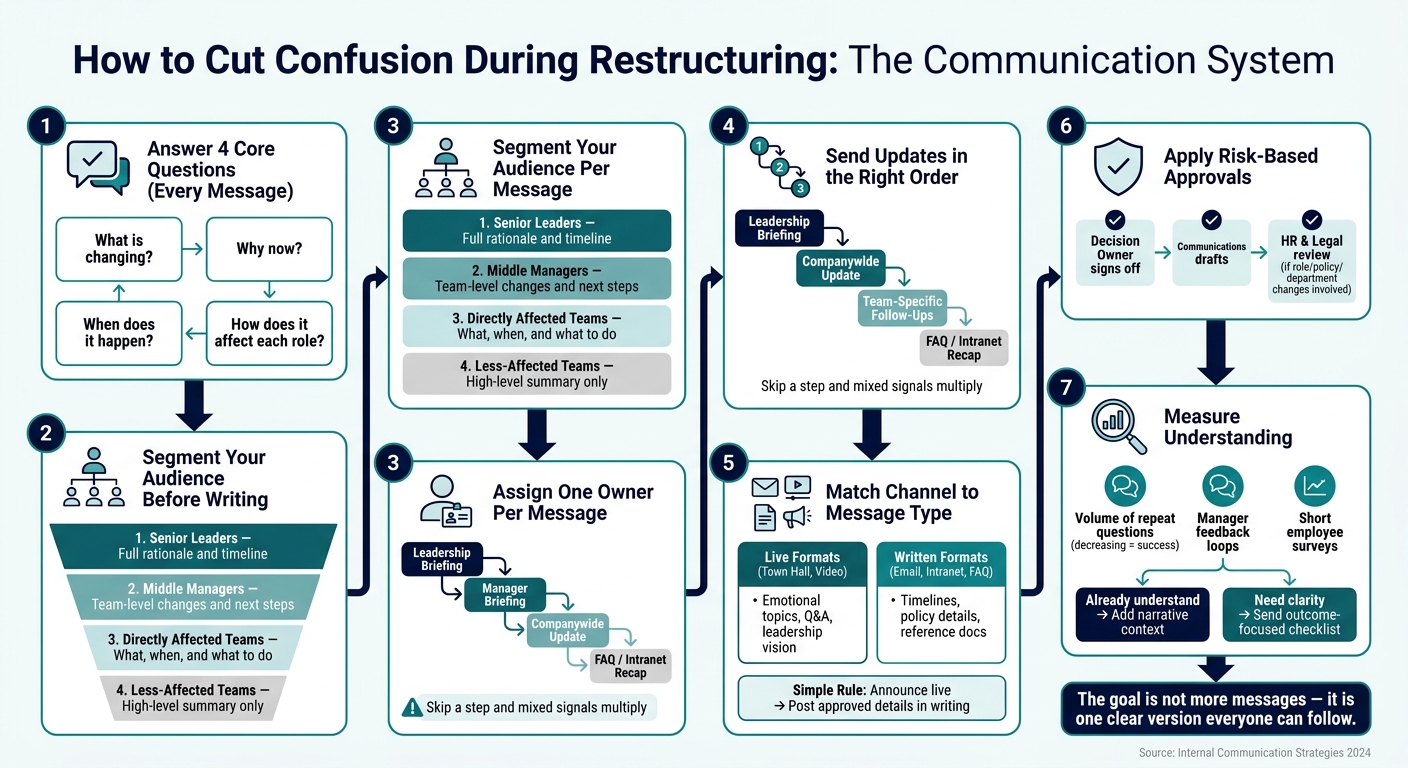
Internal Communication Flow During Restructuring: A Step-by-Step System
3 Must-Know Change Communication Principles
sbb-itb-c53a83b
Map Audiences and Assign Message Ownership
Once leaders know the core questions, the next move is to split the audience before writing the update. A single message for everyone sounds efficient, but it usually does the opposite. Some people get details they don't need, while others miss the parts that hit their work directly. So the first job is simple: decide which group gets which version of the message.
Group Employees by Role and Level of Impact
Group people by role and by how much the change affects them. Leaders set direction. Managers translate that direction into team-level terms. Teams that are directly affected need the most detail. Technical teams should get a narrower track tied to their own work.
"Communication overhead is often a byproduct of scaling." - Mario Peshev, CEO and Business Advisor
Define Who Says What to Whom
Each message needs a clear owner. Executives should explain the why and the timing. Department heads should cover milestones and reporting changes. Managers should handle day-to-day details and immediate next steps.
"Inconsistent messaging can create confusion and erode trust. A unified message helps to maintain clarity and reinforces the organization's narrative." - Mario Peshev, CEO and Author
Keep those roles separate. When too many senders overlap, people start hearing different versions of the same update. And when the line between the what and the why gets blurry, speculation fills the gap fast.
Build a Simple Message Map
A shared table with six columns is enough to keep updates lined up across the company:
| Audience | Key Message | Sender | Channel | Timing | Action Required |
|---|---|---|---|---|---|
| Senior leaders | Full restructuring rationale and timeline | CEO | Leadership meeting | Before broader announcement | Align on the narrative |
| Middle managers | Team-level changes, reporting shifts, and next steps | Department heads | Manager briefing | Before companywide communication | Prepare to answer team questions |
| Directly affected teams | What changes, when, and what to do next | Line managers or team leads | One-on-one or team briefing | As the update cascades | Understand role and process changes |
| Teams with limited day-to-day impact | High-level summary of changes | Department head | Email or intranet post | After the companywide update | Stay informed |
This map keeps every sender on the same script. It stops the update from turning into crossed wires and mixed signals. But that only happens if the approval path follows the same audience path.
Once ownership is set, the next step is to lock the order so each message lands in the right sequence.
Create a Message Flow and Approval Process That Prevents Mixed Signals
Once the message map is set, lock the delivery order. Internal updates cut confusion only when that order is under control. Timing shapes how people read the message. In practice, people react to when they hear something, not just what they hear.
Set the Update Sequence From Leadership to Managers to Teams
Start with leadership. Brief managers next. Then send the companywide update, followed by team-specific follow-ups and one FAQ or intranet recap that serves as the main reference point.
Skip a step, and mixed signals are much more likely. If managers hear the news at the same time as their teams, they can't answer questions with much confidence. That puts them on the back foot right away.
Sequence and approval need to work together. If one part is loose, the message can still split.
Use Risk-Based Approvals for Sensitive Restructuring Messages
Not every update needs the same review path. The decision owner signs off on the message. Communications writes the draft. HR and legal review any message tied to role, department, or policy changes before release.
Set the triggers ahead of time. If a message covers role changes, department closures, or policy shifts, send it to HR and legal for review. Pre-prepared templates for common restructuring scenarios can speed things up without giving up accuracy.
Ad Hoc Approvals vs. Structured Approval Workflows
Structured approvals cut mixed signals, make ownership clear, and lower risk. Ad hoc approvals can move fast, sure, but structured workflows improve consistency, accountability, and legal protection.
A documented workflow also makes it easier to spot where a message broke down before the next update goes out. Once the approval path is fixed, the next step is matching each update to the right channel.
Choose the Right Channel Mix and Update Formats
Once message ownership is set, pick channels based on how urgent and sensitive each update is. If you lean on just one channel during restructuring, people fill in the gaps on their own. That’s when confusion starts.
Match Channels to Message Type
The channel should fit the message. Topics with a lot of emotion are usually better in live formats first, where leaders can answer questions and show empathy on the spot. Written formats - like executive emails, intranet pages, and internal newsletters - are better for timelines, FAQs, and policy details that people may need to check again later.
If information is still limited early in a restructuring, a short holding statement by email can acknowledge the situation.
"The first step in effective crisis communication is to swiftly acknowledge the crisis... Delays in acknowledgment can lead to speculation, rumors, and a loss of trust."
- Mario Peshev, CEO of DevriX
Channel choice should also follow the approval path already defined. Each audience should get the same approved message, delivered in the format they can act on fastest. That kind of alignment cuts down on mixed signals.
Standardize Update Formats Employees Can Scan Quickly
Consistent templates make updates easier to scan and easier to trust. They also lower the mental effort employees need to understand what changed.
Useful formats include:
- Holding statement: a brief early update that acknowledges the situation when details are still limited
- Executive email: a formal announcement with the key timeline and next step
- Manager update: a short handoff that gives managers the approved message and a way to surface questions before they brief their teams
- FAQ page: an approved reference for common questions, process documentation, and policy changes
Each format should include the same core elements: confirmed facts only, empathy, clear action steps, and where employees can find the latest approved update. When every update follows the same pattern, people can scan it fast and know what matters.
Internal Channels Compared: Reach and Clarity
Use each channel for one clear job.
| Channel | Reach | Feedback Potential | Best Use During Restructuring |
|---|---|---|---|
| High | Low | Immediate notification of major changes; companywide visibility | |
| Intranet / Wiki | Medium | Low | Central source for FAQs, process documentation, and policy changes |
| Town Hall / Video | Medium | High | Emotionally charged topics, Q&A, and leadership vision |
| Newsletter | High | Low | Scheduled roundup of non-urgent restructuring updates |
| Manager Update | Low | High | Cascading sensitive info to specific teams and gathering feedback |
A simple rule works well here: announce live, then post the approved details in writing. Pair live updates with a written record, then check whether employees can repeat the approved message clearly.
Measure Understanding and Improve the Update System Over Time
Sending updates is not the same as being understood. If people keep asking the same questions, the system broke down somewhere. That doesn't just point to a weak message. It can also mean the message reached the wrong people, came through the wrong channel, or lacked the right level of detail.
Once an update goes out, the next job is simple: check whether people understood it.
Track Whether Employees Understand the Change
The clearest signal is repetition. When employees stop asking the same questions, the update is probably doing its job. If managers keep hearing the same concerns after an announcement, that’s a root cause worth digging into. Sometimes the problem is the wording. Other times, it’s how the message was shared.
A few simple signals can help you track this:
- Employee questionnaires
- Manager feedback
- The volume of repeat questions
The goal is to separate employees who already understand the change from employees who need a direct summary. Those groups should not get the same follow-up. The first group may need more narrative context. The second usually needs short, outcome-focused checklists.
Post-restructuring reviews matter too. After a major update cycle ends, a brief debrief with managers can show which messages cut repeat questions and which ones missed the mark. That gives the next round of updates a better starting point.
How Smaller Companies Can Run This Without a Large Communications Team
Small companies can run the same feedback loop without a big communications team. What matters is the process, not team size. As a company grows, casual communication starts to fail, so regular workflow reviews become more important.
You don’t need a stack of tools or a long menu of formats. Reusable templates are often enough to keep updates consistent. The main thing to watch is which format cut confusion the most - not how many formats were used.
Conclusion: The Key Elements of Updates That Cut Confusion
Restructuring updates cut confusion when each part of the system is deliberate: clear audience segments, defined ownership, delivery in the right order, and channels matched to the weight of the message. The best update systems don’t stop at delivery. They check comprehension, learn from what happened, and make the next round better.
FAQs
How often should restructuring updates be sent?
There’s no one required update schedule. What matters most is a regular, predictable cadence that lowers uncertainty and helps people feel informed. Weekly alignment meetings are a common way to do that.
It also helps to keep information moving between meetings. Real-time feedback loops and dashboards can give people a steady view of what’s changing, without making them wait for the next check-in. And during critical transitions, it’s smart to add proactive updates or one-on-one conversations when people need more clarity.
What should managers say if they do not have all the answers yet?
Be transparent and empathetic. Acknowledge the uncertainty instead of pretending you have all the answers.
Share what you do know, explain the next steps, and commit to regular updates as more details come in. If it fits the situation, make it clear that the organization is taking action now to protect the company’s long-term health and help support job security.
How can leaders tell whether employees trust the updates?
Leaders can measure trust by setting up steady feedback loops and keeping an eye on employee sentiment through surveys, anonymous forms, and one-on-one check-ins.
You can usually spot trust when leaders listen, respond, and change course based on what they hear. That shows employees their input leads to actual action, not just more data sitting in a spreadsheet.


