Why This Sector Study Matters for Your Next Thesis
If you run a small or mid-sized manufacturing business, operate an industrial services firm, or advise on industrials M&A, you are watching capital flow back into a sector that spent the 2010s as a secondary allocation. The questions are practical: Is this a cyclical bounce, or does the demand backdrop support a durable thesis? Where is the margin runway? Which sub-sectors reward consolidation, and which are cyclical traps dressed up as platforms?
This guide walks through the core drivers behind industrials private equity activity, the risks that separate durable investments from cyclical bets, and a usable scorecard you can apply to any target or your own business. I have spent years advising operators and investors on technology-enabled transformation in manufacturing and industrial services. The patterns here are drawn from those engagements and from the public research cited throughout.
We are not offering investment advice or a list of top firms. This is a sector study for operators and SME owners who need to understand why buy-side interest has returned, what acquirers are underwriting, and how to position a business accordingly.
Why Industrials Is Back on the Buy-Side Agenda
For much of the last decade, industrials private equity took a back seat to software, healthcare services, and consumer platforms. Multiples in those sectors stretched while manufacturing buyouts remained modest. That dynamic has reversed. According to Bain's 2024 Global Private Equity Report, industrials deal value in North America rose to its highest share of total buyout activity since 2018, driven by reshoring tailwinds, infrastructure spending, and the energy transition.
The shift is not simply capital searching for yield. Three structural forces are converging:
- Supply-chain reconfiguration: COVID-era disruptions and geopolitical friction have forced OEMs and distributors to shorten supply chains. Nearshoring and reshoring create demand for domestic manufacturing capacity, tooling, and maintenance services.
- Policy support: The CHIPS Act, Inflation Reduction Act, and Infrastructure Investment and Jobs Act have unlocked hundreds of billions in incentives for domestic production, clean energy, and grid modernization.
- Valuation reset: After a decade of software premium multiples, industrials valuations look attractive on a risk-adjusted basis. Many sub-sectors trade at 6-8x EBITDA, offering room for multiple expansion if operational improvements materialize.
For SME owners, this means heightened acquirer interest. For operators evaluating targets, it means crowded auctions in attractive niches and the need for sharper diligence on what separates a resilient platform from a cyclical bet.
Reshoring, Supply-Chain Resilience, and the Demand Backdrop
The reshoring investment thesis is not speculative. The Reshoring Initiative reported that reshoring and foreign direct investment (FDI) job announcements reached over 364,000 in 2023, the highest level since they began tracking in 2010. This is not a single-year spike. Announcements have grown year-over-year since 2020.
What does this mean for manufacturing private equity? Demand for domestic production capacity, specialty components, and the services that support them, from contract manufacturing to industrial maintenance, is structurally higher than it was five years ago. OEMs building new facilities need local supply chains. Distributors are adding inventory closer to end customers to reduce lead times.
Where the Demand Is Concentrated
Not all industrials benefit equally. The strongest demand backdrop appears in:
- Semiconductor and electronics manufacturing: CHIPS Act funding is accelerating fab construction, creating demand for precision machining, cleanroom services, and specialty chemicals.
- Electric vehicle and battery supply chains: OEMs and battery manufacturers are localizing production, pulling component suppliers and tooling providers along.
- Critical infrastructure: Grid modernization, water treatment, and transportation infrastructure require domestic fabrication and maintenance services.
For SMEs in these adjacencies, the opportunity is clear: demand is rising, and larger platforms are looking to acquire capacity. For investors, the question is whether that demand is durable or a policy-driven bubble. The answer depends on the specific end market and the stickiness of the customer relationships.
Automation, Energy Transition, and Margin-Expansion Runway
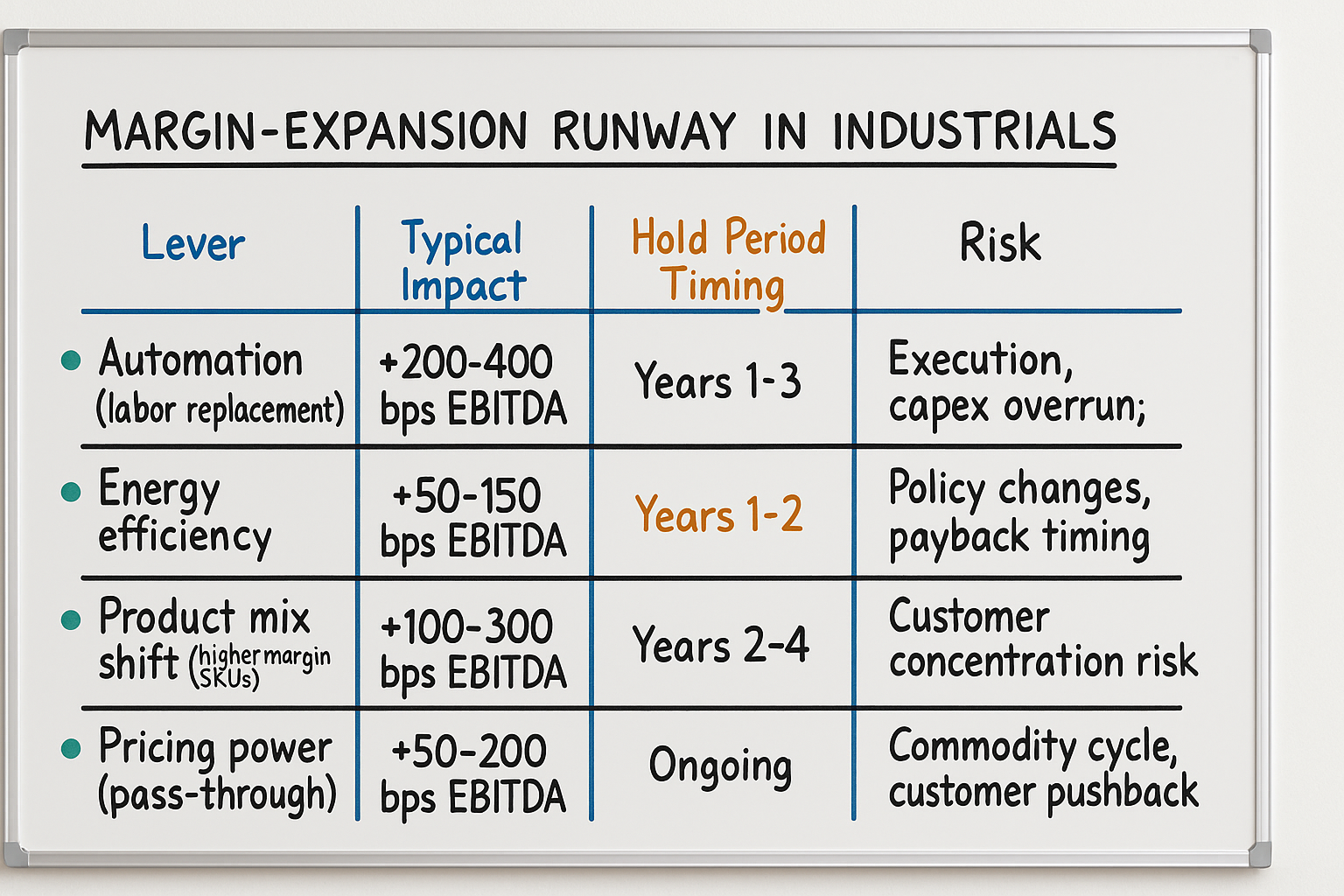
Industrials private equity is not just a demand story. The margin-expansion runway matters as much as top-line growth. Two forces are creating that runway: automation and energy transition.
Automation as a Value-Creation Lever
Labor constraints in manufacturing are well documented. According to Deloitte's 2024 Manufacturing Industry Outlook, the sector could face a shortfall of 2.1 million skilled workers by 2030. For acquirers, this creates an opportunity: buy businesses with manual processes, invest in automation, and improve EBITDA margins while reducing reliance on scarce labor.
This thesis plays out in precision machining, fabrication, warehousing, and distribution. The private equity value creation playbook here is straightforward: identify businesses where automation capex can deliver 200-400 basis points of margin improvement over a three-to-five-year hold.
Energy Transition as a Demand and Cost Lever
The energy transition creates demand for industrial equipment (transformers, grid components, heat pumps) and services (installation, maintenance, decommissioning). It also offers cost-reduction opportunities. Manufacturers investing in on-site solar, energy storage, or efficiency upgrades can reduce operating costs and improve EBITDA, often with policy incentives covering a portion of the capex.
McKinsey's research on the energy transition estimates that global investment in clean energy and related infrastructure will need to triple by 2030 to meet net-zero goals. For industrials, this is a multi-decade demand tailwind in specific sub-sectors.
Fragmentation in Industrial Services and Distribution
The consolidation opportunity in industrial services and distribution remains one of the most durable themes in manufacturing private equity. These sub-sectors are highly fragmented, with thousands of small, often family-owned businesses serving local or regional markets.
Consider industrial maintenance services: HVAC, electrical, mechanical, and controls work for manufacturing facilities. The top 10 providers hold a small fraction of the market. The same pattern holds in industrial distribution, from MRO (maintenance, repair, and operations) supplies to specialty chemicals to fasteners.
Why Fragmentation Persists
Several factors keep these markets fragmented:
- Relationship-driven sales: Customers value local presence, responsiveness, and long-standing relationships. National scale does not automatically translate to customer wins.
- Low barriers to entry: Starting a small industrial services business or distributorship requires modest capital. New entrants continuously emerge.
- Owner-operator economics: Many businesses generate attractive returns for a single owner but lack the scale or systems to attract institutional capital on their own.
For acquirers, this fragmentation creates a platform opportunity. Build or buy a well-run business, professionalize operations, and execute tuck-in acquisitions to add geographic coverage, customer relationships, or product lines. The industry consolidation playbook is well established here, but execution is demanding. Integration failures, customer attrition, and key-man risk are common pitfalls.
For SME owners, the message is clear: acquirers are actively hunting in fragmented industrials sub-sectors. If your business has strong customer relationships, recurring revenue, and a defensible niche, you are likely on someone's target list. Understanding the consolidation thesis helps you position for a favorable exit or, alternatively, participate as a platform buyer yourself.
Understanding Market Fragmentation in Industrials
The concept of market fragmentation deserves a closer look. In industrials, fragmentation is not uniform. Some sub-sectors are ripe for consolidation; others resist it despite apparent fragmentation.
Fragmentation That Rewards Consolidation
The best consolidation targets share several characteristics:
- Back-office synergies: Accounting, HR, IT, and procurement can be centralized across multiple locations, reducing overhead.
- Purchasing power: Scale enables better terms from suppliers, improving gross margins.
- Cross-selling: A broader product or service portfolio increases wallet share with existing customers.
- Brand and marketing leverage: A unified brand can win larger contracts or national accounts that fragmented competitors cannot serve.
Fragmentation That Resists Consolidation
Other sub-sectors remain fragmented because consolidation does not create value:
- Hyper-local service delivery: If customers will not accept a provider outside their immediate geography, national scale adds cost without revenue.
- Low switching costs: If customers shop every job, relationships do not compound, and a platform has no stickiness.
- Key-man dependency: If the value is in the owner's relationships, not the business's systems, integration destroys value.
When building a private equity investment thesis in industrials, the fragmentation question is central. The scorecard below helps distinguish between attractive consolidation targets and fragmented markets that will remain fragmented.
Cyclicality, Working Capital, and Capex as Underwriting Risks
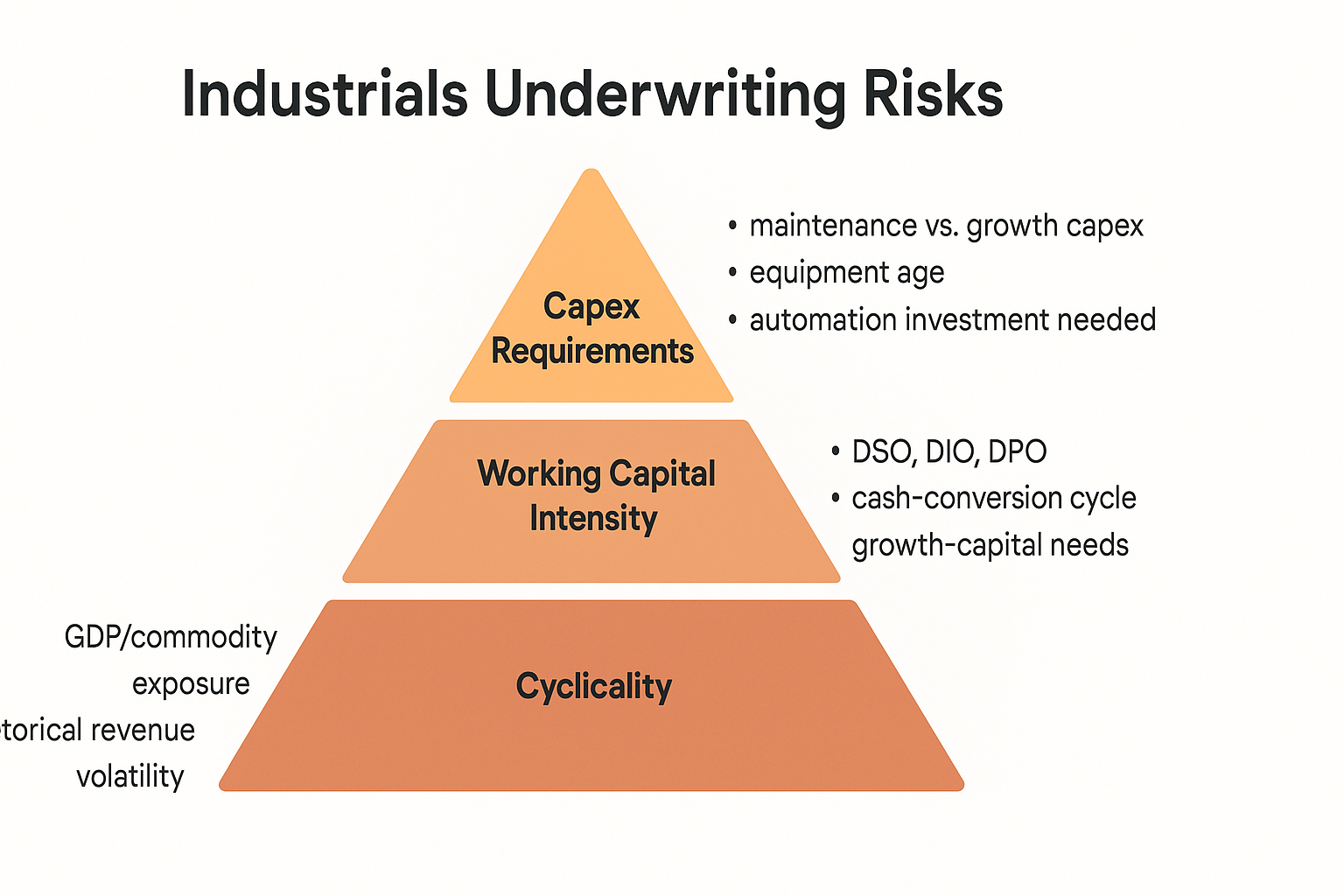
Industrials carry risks that software and services businesses do not. Three deserve particular attention: cyclicality, working capital intensity, and capex requirements.
Cyclicality
Many industrials sub-sectors track GDP, construction activity, or commodity prices. When the economy slows, order books thin, and EBITDA compresses. BCG's 2023 Private Equity Report noted that industrials and materials showed the widest dispersion in returns among buyout sectors, reflecting this cyclical exposure.
Underwriting a cyclical business requires stress-testing revenue and margins against historical downturns. Acquirers often use conservative multiples or structure deals with earnouts tied to performance to mitigate risk. SME owners selling into a strong cycle should expect buyers to discount peak-year earnings.
Working Capital Intensity
Inventory and receivables can consume significant cash in manufacturing and distribution. A business growing 20% may need substantial working capital investment to support that growth, reducing free cash flow available for debt service or distributions. In diligence, acquirers scrutinize days sales outstanding (DSO), days inventory outstanding (DIO), and days payable outstanding (DPO) to understand the cash-conversion cycle.
Capex Requirements
Maintenance capex and growth capex are different, and the distinction matters. A business with aging equipment may have suppressed capex in recent years, flattering EBITDA. Acquirers will normalize for required maintenance spending. Growth capex, such as new production lines or automation investments, is discretionary but may be necessary to realize the value-creation plan.
For private equity market intelligence on industrials, these three risks, cyclicality, working capital, and capex, are the underwriting gates. A business with a strong demand backdrop and margin runway can still be a poor investment if cash requirements are underestimated.
Signals of a Resilient Business Versus a Cyclical Trap
Distinguishing between a resilient industrials platform and a cyclical trap is the core diligence challenge. Here are the signals that matter:
Resilient Signals
- Recurring or contractual revenue: Service agreements, maintenance contracts, and long-term supply agreements reduce revenue volatility.
- Aftermarket exposure: Businesses with a meaningful share of revenue from parts, service, and consumables are less cyclical than those dependent on new equipment sales.
- Customer diversification: No single customer represents more than 10-15% of revenue, reducing concentration risk.
- Mission-critical positioning: Products or services that cause significant pain if unavailable (e.g., downtime, safety, compliance) command pricing power and resist cuts during downturns.
- Historical margin stability: EBITDA margins that held up during the 2008-2009 recession, 2015-2016 industrial slowdown, or 2020 COVID disruption indicate resilience.
Cyclical Trap Signals
- Project-based revenue: Businesses dependent on large, one-time projects see lumpy revenue and margin volatility.
- Commodity exposure: Revenue or margins tied to steel, oil, or other commodity prices fluctuate with cycles.
- New construction dependency: Businesses serving new construction, rather than maintenance or renovation, face sharper downturns.
- Customer concentration: Heavy reliance on one or two large customers amplifies risk.
- Deferred capex: Equipment that should have been replaced years ago signals future cash requirements.
When I advise operators on positioning for a sale, we focus on these signals. Strengthening recurring revenue, diversifying the customer base, and demonstrating margin stability through a cycle all improve valuation and deal certainty.
Sub-Sectors Exposed to Structural Decline
Not every industrials sub-sector benefits from reshoring and energy transition. Some face structural headwinds that no operational improvement can overcome.
Thermal Coal Equipment and Services
As utilities retire coal-fired power plants, demand for mining equipment, maintenance services, and related logistics is in permanent decline. The International Energy Agency's World Energy Outlook 2023 projects coal demand in advanced economies will fall by more than 40% by 2030.
Internal Combustion Engine Components
Component suppliers serving legacy ICE drivetrains face a structural shift as EV adoption accelerates. The transition timeline varies by region and vehicle class, but the direction is clear. Suppliers without a path to EV or hybrid platforms face declining volumes.
Single-Use Plastics Manufacturing
Regulatory pressure and consumer sentiment are reducing demand for certain single-use plastics. Manufacturers heavily exposed to these products face margin pressure and potential stranded assets.
Print-Related Industrials
Commercial printing, paper manufacturing, and related services continue a multi-decade decline as digital adoption reduces demand. Pockets of resilience exist (packaging, specialty printing), but broad exposure to commercial print is a structural headwind.
For SME owners in these sub-sectors, the strategic options are narrower. Pivoting to adjacent markets, finding a buyer who values the remaining cash flows, or managing an orderly wind-down may be the realistic paths. For acquirers, these sub-sectors are typically screens-out in the thesis, regardless of valuation.
The Industrials-Thesis Scorecard
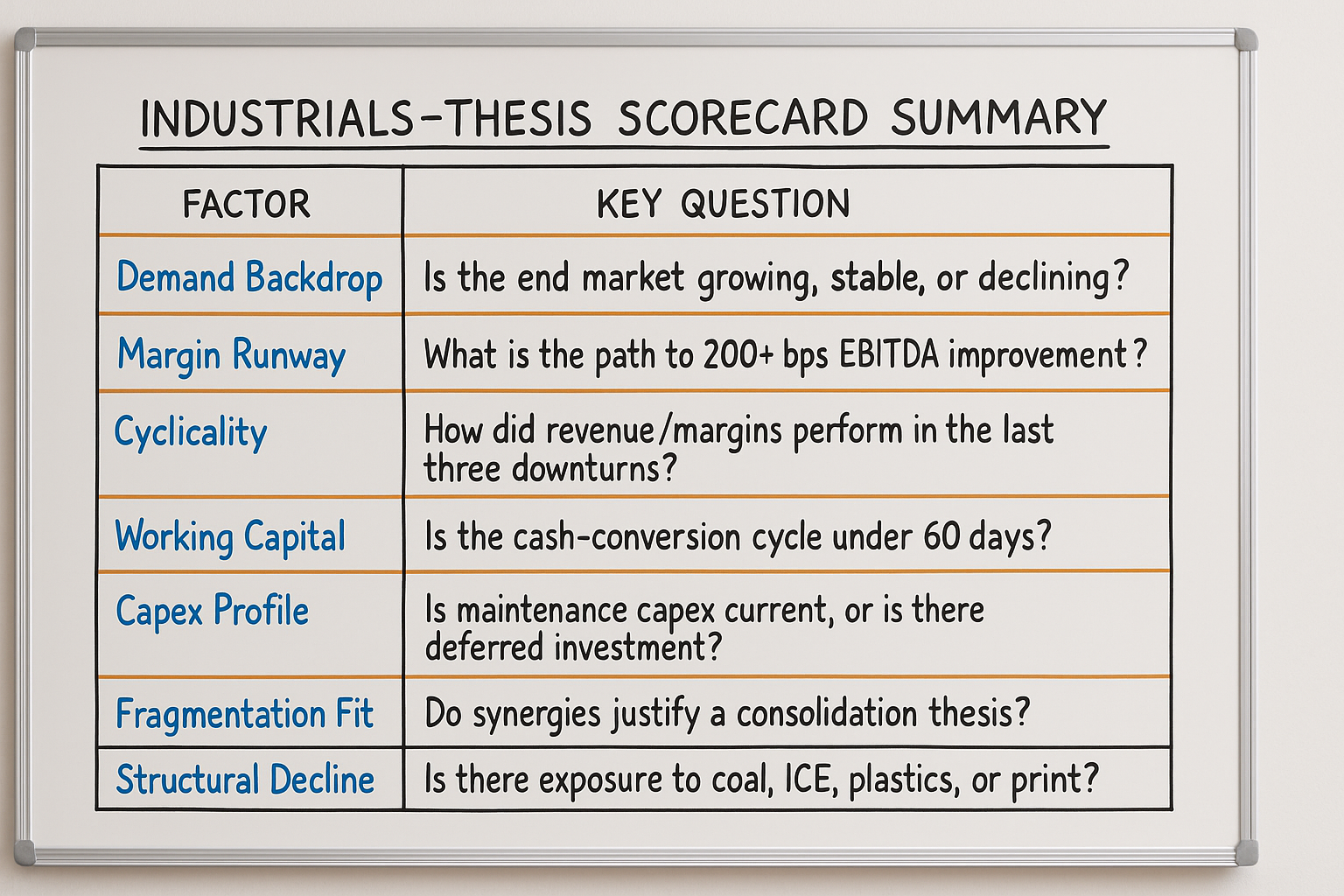
The following scorecard synthesizes the factors discussed above into a usable framework. Apply it to any industrials target or use it to assess your own business's positioning for a sale or growth investment.
| Factor | What to Assess | Strong Signal | Weak Signal | Weight |
|---|---|---|---|---|
| Demand Backdrop | End-market growth drivers, policy tailwinds, reshoring exposure | Serves reshoring, infrastructure, or energy transition end markets; multi-year demand visibility | Commodity-dependent; declining end market; single large project pipeline | High |
| Margin Runway | Automation potential, pricing power, energy efficiency, product mix | Clear path to 200+ bps EBITDA improvement; pricing power demonstrated | Already optimized; commodity pricing; high labor share with no automation path | High |
| Cyclicality | Historical revenue/margin volatility, customer concentration, aftermarket mix | Margin stability through 2008-09, 2015-16, 2020; aftermarket 30%+ of revenue | Revenue dropped 30%+ in prior downturns; project-based; top customer 25%+ | High |
| Working Capital Intensity | Cash-conversion cycle, DSO, DIO, DPO, growth-capital needs | Cash-conversion cycle under 60 days; growth self-funded | Cash-conversion cycle over 120 days; growth requires significant working capital injection | Medium |
| Capex Profile | Maintenance vs. growth capex, equipment age, technology currency | Capex under 4% of revenue; recent equipment; no deferred maintenance | Significant deferred capex; aging equipment; obsolescence risk | Medium |
| Fragmentation / Consolidation Fit | Market structure, synergy potential, key-man risk, switching costs | Clear back-office synergies; purchasing power gains; low key-man risk | Hyper-local; no synergy path; value tied to owner relationships | Medium |
| Structural Decline Exposure | End-market trajectory, regulatory risk, technology substitution | No exposure to declining end markets; positioned for transition | Heavy exposure to coal, ICE, single-use plastics, or commercial print | High (screen-out) |
Use this scorecard in three ways:
- Target screening: Score each factor for a potential acquisition. A target with weak signals on demand backdrop, cyclicality, or structural decline exposure should be a pass, regardless of valuation.
- Value-creation planning: Identify which factors offer improvement potential. A business with strong demand but weak margin runway may benefit from automation investment. A business with fragmentation fit but high working capital intensity may need operational focus on the cash-conversion cycle.
- Exit positioning: If you are preparing your business for sale, use the scorecard to identify weaknesses and address them before going to market. Strengthening recurring revenue, reducing customer concentration, and demonstrating margin stability all improve your position.
Applying the Framework to a Representative Scenario
To show how the scorecard works in practice, consider an illustrative scenario (not a real company or engagement):
Scenario: A regional industrial maintenance services provider serving food and beverage manufacturing facilities. Revenue of $25 million, EBITDA margin of 12%, no single customer over 8% of revenue. The business has grown 6% annually for the past five years and has a mix of contract and on-call work.
Applying the scorecard:
- Demand Backdrop: Strong. Food and beverage manufacturing is non-cyclical. Reshoring and food-safety regulations support ongoing demand for maintenance services.
- Margin Runway: Moderate. Automation potential is limited in field services, but route optimization, technician productivity tools, and pricing discipline could add 100-200 bps.
- Cyclicality: Low. The business maintained revenue through 2020. Contract revenue provides stability.
- Working Capital Intensity: Low. Services businesses typically have low inventory and manageable receivables. DSO under 45 days.
- Capex Profile: Low. Primary assets are vehicles and tools, with modest annual replacement needs.
- Fragmentation Fit: Strong. The market is highly fragmented. Tuck-in acquisitions could add geographic coverage and cross-sell opportunities.
- Structural Decline Exposure: None. No exposure to declining end markets.
This profile suggests a resilient platform candidate. The thesis would focus on consolidation (tuck-in acquisitions), modest margin improvement, and multiple expansion as the business scales.
Summary and Actionable Takeaways
Industrials private equity has returned to the buy-side agenda for structural reasons: reshoring, policy support, automation, and the energy transition create a demand backdrop and margin runway that did not exist a decade ago. For SME owners and operators, this means heightened acquirer interest and the need to understand what separates attractive targets from cyclical traps.
Key takeaways:
- Demand backdrop matters: Sub-sectors serving reshoring, infrastructure, and energy transition have multi-year tailwinds. Commodity-dependent or declining end markets are screens-out.
- Margin runway is a value-creation lever: Automation, energy efficiency, and pricing discipline can deliver 200-400 bps of EBITDA improvement in the right businesses.
- Fragmentation enables consolidation, but not everywhere: Look for back-office synergies, purchasing power, and low key-man risk. Avoid hyper-local markets where scale does not create value.
- Cyclicality, working capital, and capex are the underwriting risks: Stress-test revenue and margins against historical downturns. Normalize for required maintenance capex. Understand the cash-conversion cycle.
- Use the scorecard: Apply the industrials-thesis scorecard to any target or your own business. It surfaces the factors that matter and identifies where to focus diligence or improvement efforts.
Whether you are evaluating an industrials M&A opportunity, positioning your business for sale, or building a thesis for an industrial services consolidation, the framework above provides a practical starting point. The sector is attracting capital for real reasons, but not every deal will work. Discipline on the underwriting risks separates the winners from the cyclical traps.
Subscribe to the Growth Shuttle research briefing for the industrials-sector briefing, and download the Industrials-Thesis Scorecard.


