If you allocate capital to private equity or compete against PE-backed businesses, the emerging managers private equity segment deserves sharper attention than most market participants give it. These first-time funds and spin-out GPs now account for a meaningful share of deal activity in the lower middle market, and their structural characteristics create both opportunities and risks that differ materially from established firms.
The question is not whether emerging managers exist. The question is whether their edges are durable, their risks are manageable, and their presence reshapes competitive dynamics in ways that affect your own deal sourcing, portfolio positioning, or capital deployment. This guide examines the emerging manager landscape through an operator lens, covering where new private equity firms structurally outperform, where they fall short, and how to evaluate whether a specific emerging manager represents a rising franchise or a one-fund story.
1. Why the Emerging Manager Segment Holds Structural Edges
The thesis for emerging managers rests on a few observable dynamics that play out repeatedly across fund vintages. According to Cambridge Associates research, first-time and second-time funds have historically generated higher median net IRRs than established managers in certain periods, though with wider dispersion. The structural reasons matter more than the statistics.
First, emerging managers operate with concentrated portfolios. A $150 million fund making eight to twelve investments cannot hide behind portfolio diversification. Every deal matters. This concentration forces discipline in sourcing and diligence that larger funds can dilute across dozens of positions.
Second, the GP economics of a first-time fund create different incentives. A new GP's personal wealth is disproportionately tied to Fund I performance. The management fee on a small fund barely covers operating costs, so the real compensation comes from carry on realized gains. This alignment is not theoretical. It shows up in how emerging managers behave during deal processes, how they manage portfolio companies, and how they allocate their own time.
Third, emerging managers often bring thesis-driven strategies that larger funds cannot pursue. A sector specialist who spent fifteen years operating software businesses can build a fund around a specific vertical where their knowledge creates genuine information asymmetry. Larger funds pursuing the same deals rely on generalist associates and external consultants to replicate expertise that the specialist GP embodies personally.
The Sourcing Reality for Smaller Funds
Proprietary deal flow is overused as a term, but emerging managers do access transactions that larger funds structurally cannot. Many lower middle market businesses prefer selling to a buyer who will remain personally involved. Founders often choose smaller funds specifically because they want to work with the GP directly rather than being handed off to a junior deal team after close.
This preference creates a sourcing advantage that compounds over time. Intermediaries develop relationships with emerging managers who perform well, and those relationships generate repeat deal flow. For anyone tracking private equity deal flow patterns, the concentration of certain transaction types among smaller managers is measurable.
2. Spin-Outs, Sector Specialists, and the Sourcing Advantage
The emerging manager landscape is not monolithic. Understanding the different GP archetypes helps explain why performance dispersion is so wide within the segment.
Spin-out GPs leave established platforms to pursue strategies that their former firms would not support. Sometimes the spin-out reflects a sector thesis that did not fit the larger fund's generalist mandate. Sometimes it reflects the GP's desire for more control over investment decisions. Spin-out GPs typically bring institutional experience, established LP relationships, and often a track record they can attribute to their own deal leadership. The Preqin spin-out manager analysis shows these managers often raise capital more quickly than first-time managers without institutional backgrounds.
Sector specialists build funds around deep domain expertise. Healthcare services, industrial technology, food and beverage, and business services each have emerging managers who focus exclusively on that vertical. Their advantage is pattern recognition. A GP who has seen fifty transactions in a specific sector understands which operational levers work, which integration approaches fail, and which business models deserve premium valuations. This knowledge translates into faster diligence, more accurate underwriting, and better post-close execution.
Geographic specialists focus on regions where national funds have limited presence. The Southeast, Mountain West, and certain Midwest markets have emerging managers who built networks over decades of local operating or investment activity. These GPs access deals through relationships that cannot be replicated by flying in from New York or San Francisco.
Where Sourcing Advantage Becomes Competitive Moat
The sourcing advantage of emerging managers creates competitive pressure on larger funds in specific market segments. As documented in middle market private equity analysis, transactions below $50 million in enterprise value increasingly feature emerging managers as the winning bidders. Larger funds cannot deploy meaningful capital at this size, and their cost structures do not support the intensity of diligence that small deals require.
For SME operators considering private equity partnerships, this dynamic has practical implications. The emerging manager who pursues your business may offer more attention, more alignment, and more relevant operating experience than a larger fund. The tradeoff involves infrastructure, follow-on capital capacity, and brand recognition that can matter for customer relationships or talent acquisition.

3. How Alignment and Incentives Shape Smaller-Fund Performance
The alignment argument for emerging managers is straightforward but often understated. When a GP's net worth depends overwhelmingly on Fund I performance, their behavior differs from a GP who manages multiple funds, earns significant management fees, and has already built personal wealth from prior carry.
This alignment manifests in several observable ways. Emerging managers spend more time with portfolio companies because they have fewer companies and less organizational complexity. They make faster decisions because they are the decision-makers, not principals who need to consult investment committees. They negotiate harder on purchase price because overpaying has direct, personal consequences.
The hunger component is harder to measure but consistently noted by intermediaries, lenders, and portfolio company executives. First-time funds compete for every deal. They respond faster, move through diligence more quickly, and work harder to win competitive processes. This intensity sometimes leads to mistakes, but it also generates wins that more complacent buyers miss.
Return Profile Expectations
The return profile of smaller funds reflects both structural advantages and constraints. According to Bain's Global Private Equity Report, smaller funds have historically shown higher return dispersion, meaning the best performers significantly outperform while the worst significantly underperform. This dispersion reflects the concentrated nature of small portfolios and the variance in GP quality.
For capital allocators, the implication is that manager selection matters more in the emerging manager segment than in established manager allocations. A top-quartile emerging manager may generate meaningfully higher returns than a top-quartile mega-fund, but a bottom-quartile emerging manager may generate losses that a diversified large fund would avoid.
The fee economics also differ. While headline management fees and carry percentages are often similar to larger funds, the actual dollar amounts are smaller. A 2% management fee on a $100 million fund generates $2 million annually, which barely covers a small team's salaries and operating expenses. This creates pressure to deploy capital productively and realize gains that generate carry.
4. The Risks: Key-Person, Infrastructure, and Durability
Emerging managers carry risks that established platforms have mitigated through scale, diversification, and institutional development. Ignoring these risks leads to allocation mistakes.
Key-Person Risk
Many first-time funds depend critically on one or two individuals. If the lead GP becomes incapacitated, exits the firm, or simply burns out, the fund may struggle to complete its investment period or manage existing portfolio companies effectively. This key-person risk is not theoretical. The private equity industry has examples of promising emerging managers who failed to complete Fund I or raise Fund II because of GP departures or disputes.
Evaluating key-person risk requires examining partnership structures, compensation arrangements, and succession planning. Does the fund have key-person provisions that protect LPs? Are there junior team members who could step into leadership roles? What happens to carried interest if a GP departs?
Infrastructure Gaps
Established funds have finance teams, legal departments, investor relations professionals, and operating partners. Emerging managers often have the GP, an associate, and a part-time CFO. This infrastructure gap creates operational risks that can affect fund performance.
Portfolio company support may be limited. Reporting may be inconsistent. LP communication may lag behind expectations. These infrastructure gaps do not necessarily prevent strong investment returns, but they create friction that sophisticated LPs notice.
Durability Questions
The private equity fundraising environment has become more challenging, and many first-time funds will not raise a successor fund. This durability risk matters for portfolio companies that may need follow-on capital and for LPs who prefer backing managers with long-term franchise potential.
According to McKinsey's private markets analysis, LP consolidation toward established managers has accelerated in recent years, making it harder for emerging managers to raise capital even when Fund I performance is strong. This fundraising headwind affects manager behavior, potentially creating pressure to exit investments prematurely or to pursue riskier strategies that might generate eye-catching returns. Research from the SEC's Office of Investor Education also highlights that first-time funds face additional scrutiny in terms of operational governance, which can impact both fundraising timelines and ongoing LP confidence.
5. Signals That Separate a Rising Franchise from a One-Fund Story
Identifying which emerging managers will build durable franchises requires examining signals that predict persistence and scalability.
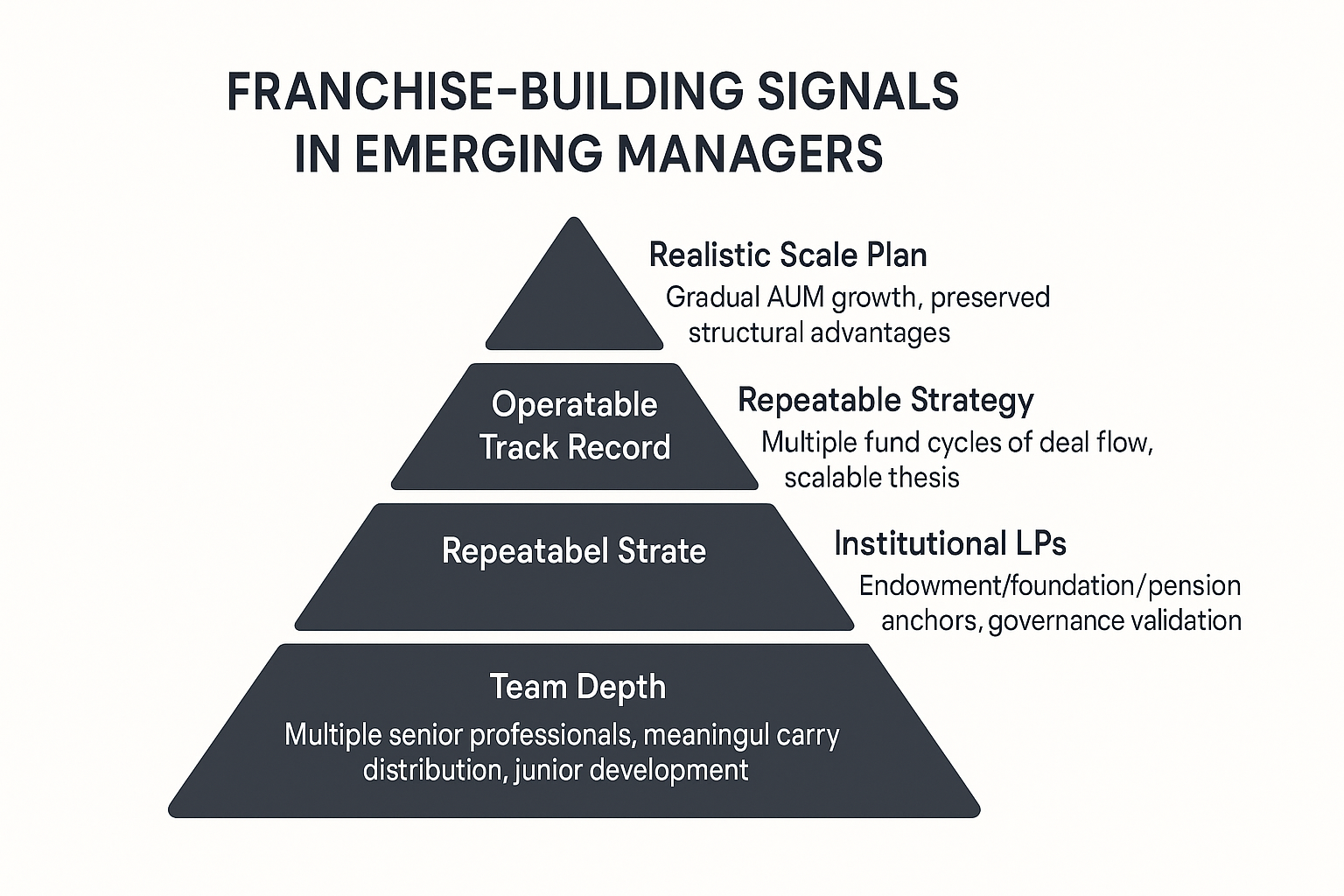
Team depth beyond the lead GP. Rising franchises build teams that can survive the departure of any single individual. This means senior professionals with meaningful carry participation, clear roles in deal origination and portfolio management, and visible development of junior talent.
Institutional LP participation. When sophisticated institutional LPs commit to an emerging manager, it signals validation of the GP's capabilities and strategy. Endowments, foundations, and pension funds conduct extensive diligence and bring governance expectations that professionalize fund operations.
Differentiated strategy with repeat potential. Some emerging manager strategies are one-time opportunities. A GP might have unique access to a specific transaction or a non-replicable information advantage. Rising franchises have strategies that can generate deal flow across multiple fund cycles.
Evidence of operational value creation. Track record analysis should examine not just returns but how those returns were generated. Did the GP grow revenue and EBITDA at portfolio companies? Or did returns come primarily from multiple expansion and leverage? Operational value creation is more repeatable than financial engineering.
Realistic fundraising trajectory. Rising franchises articulate sensible growth plans. A fund that plans to triple AUM from Fund I to Fund II may be chasing management fees rather than building a sustainable business. Gradual scaling preserves the structural advantages that made Fund I successful.
6. Countercase: Where Scale and Brand Still Win
The structural advantages of emerging managers do not apply universally. Understanding where scale and brand create genuine competitive moats prevents overallocation to the emerging manager segment.
Large Transactions and Complex Situations
Transactions above $500 million in enterprise value generally require capital and expertise that emerging managers cannot provide. Carve-outs from large corporations, take-privates of public companies, and multi-geography platform builds favor established funds with deep resources.
Complex situations also favor scale. Distressed investments, bankruptcy proceedings, and heavily regulated industries require specialized capabilities that emerging managers rarely possess. A healthcare services platform building through add-on acquisitions across multiple states needs regulatory expertise, integration playbooks, and management resources that small funds cannot easily assemble.
Brand Value in Talent and Customer Relationships
For certain portfolio companies, association with a recognized private equity brand creates tangible value. Executive recruiting becomes easier when a company is backed by a fund with a strong reputation. Customer acquisition may benefit when enterprise buyers see a credible financial sponsor. Debt financing often comes at better terms when lenders have long relationships with the PE fund.
These brand benefits are difficult to quantify but real. An emerging manager backing a business that needs to hire a Fortune 500-caliber CFO may struggle to compete against an established fund that has placed dozens of executives in similar roles.
Follow-On Capital and Platform Building
Add-on acquisitions require capital that small funds may not have. A $100 million fund that deploys $15 million in an initial platform investment may lack the capacity to fund significant add-on acquisitions, especially if those acquisitions require equity co-investment. Larger funds can commit follow-on capital from the same fund, maintain acquisition capacity across the portfolio, and support ambitious platform-building strategies.
As noted in private equity market trends analysis, buy-and-build strategies have become increasingly central to value creation, and these strategies favor funds with significant capital reserves.
7. What This Means for the Competitive Deal Map in the Middle Market
The growth of the emerging manager landscape reshapes competitive dynamics in ways that affect all market participants.
For business owners considering a sale, the buyer universe has expanded. Emerging managers compete actively for transactions below $50 million in enterprise value, and their participation can create competitive tension that benefits sellers. However, owners should understand the tradeoffs between emerging and established buyers: more attention versus more resources, higher alignment versus less infrastructure, sector expertise versus brand value.
For established funds, emerging managers represent both competition and deal flow. Competition manifests in processes where smaller funds bid aggressively on platform investments. Deal flow emerges when emerging managers seek partnership on larger transactions or when they develop portfolio companies that become attractive acquisition targets for larger platforms.
For LPs, the emerging manager segment requires differentiated evaluation approaches. The signals that predict success in established managers (stable teams, consistent returns, large AUM) may be less relevant than signals that predict franchise-building potential (differentiated strategy, institutional backing, operational value creation).
For anyone tracking private equity market intelligence, the emerging manager segment deserves ongoing attention. First-time funds and spin-out GPs now participate in enough transactions to affect market clearing prices, deal terms, and competitive positioning across the lower middle market.
8. Building the Emerging Manager Evaluation Scorecard
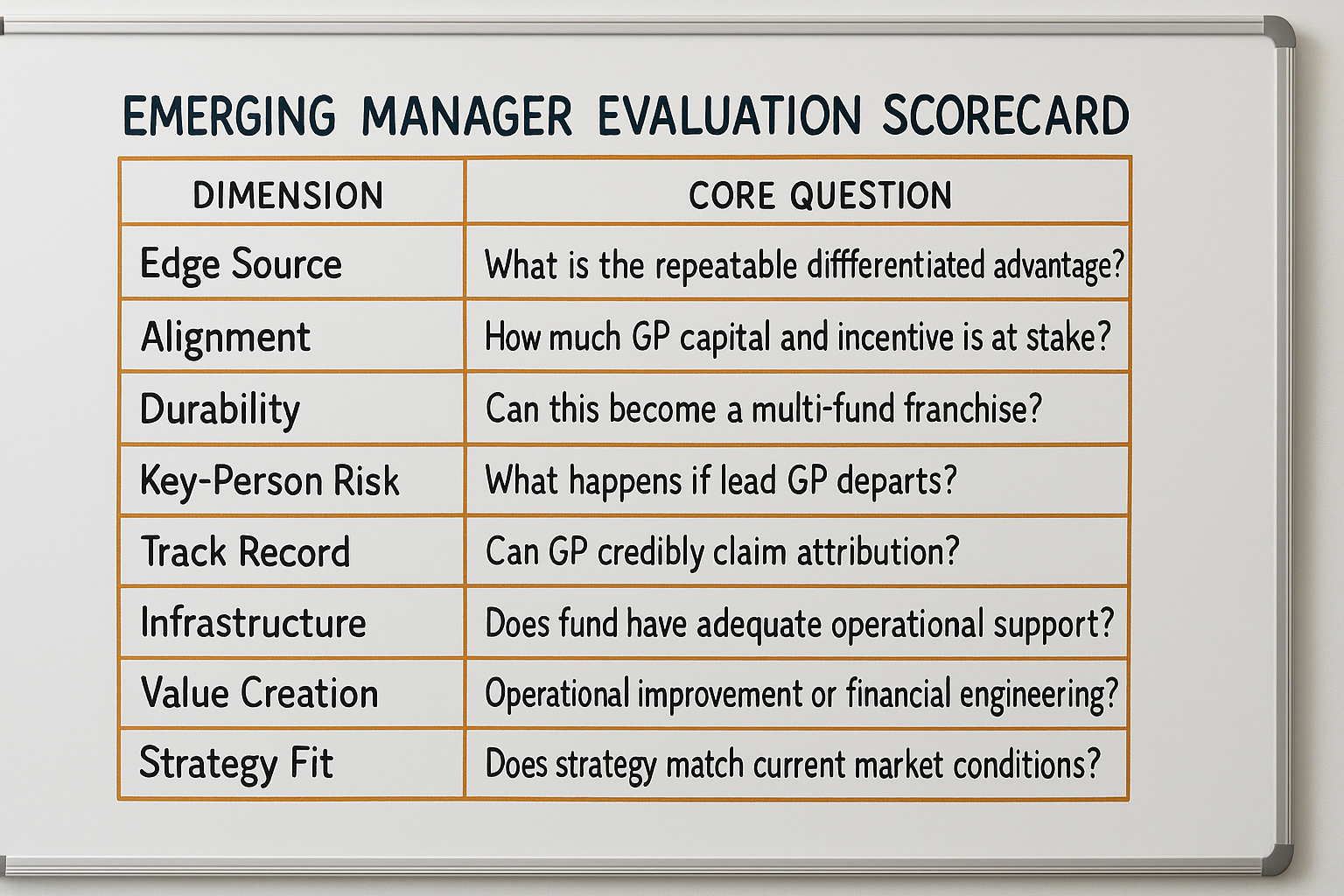
Evaluating emerging managers requires a structured approach that examines multiple dimensions. The following scorecard synthesizes the evaluation criteria discussed throughout this guide into a usable framework.
| Evaluation Dimension | Key Questions | Strong Signal | Weak Signal | Score (1-5) |
|---|---|---|---|---|
| Edge Source | What is the GP's differentiated advantage? Is it replicable across fund cycles? | Deep sector expertise, proprietary relationships, or unique operating capability with clear repeatability | Generic strategy, reliance on single relationship, or non-replicable one-time advantage | ___ |
| Alignment | How much GP capital is at risk? What is the carry structure? | Meaningful GP commitment (2%+ of fund), standard carry with appropriate hurdle, no excessive fee structures | Minimal GP commitment, unusual fee arrangements, or carry structures that misalign incentives | ___ |
| Durability | Can this manager build a multi-fund franchise? | Institutional LP base, team depth, realistic scaling plan, strategy with multi-cycle deal flow | Reliance on high-net-worth individuals, minimal team, aggressive scaling ambitions, narrow strategy | ___ |
| Key-Person Risk | What happens if the lead GP departs or becomes incapacitated? | Multiple senior professionals, clear succession plan, protective LP provisions, distributed carry | Single-GP dependency, no succession planning, concentrated carry, weak governance provisions | ___ |
| Track Record Attribution | Can the GP credibly claim responsibility for prior investment outcomes? | Clear deal leadership on multiple investments, verifiable operational involvement, auditable returns | Team attribution on prior deals, limited decision authority, unverifiable claims | ___ |
| Infrastructure Adequacy | Does the fund have sufficient operational resources? | Appropriate back-office support, clear reporting cadence, portfolio company support capability | Minimal infrastructure, inconsistent reporting, no portfolio support resources | ___ |
| Operational Value Creation | Does the track record show genuine operational improvement or primarily financial engineering? | Evidence of revenue growth, margin expansion, and capability building at portfolio companies | Returns driven primarily by leverage and multiple expansion without operational improvement | ___ |
| Strategy-Market Fit | Does the fund's strategy match current market conditions and deal availability? | Strategy aligned with observable deal flow, reasonable deployment pacing, sensible return assumptions | Strategy dependent on market conditions that have changed, unrealistic deployment or return targets | ___ |
Scoring guidance: Each dimension receives a score from 1 (significant concern) to 5 (strong positive signal). Total scores above 32 indicate a manager worthy of deeper diligence. Scores between 24 and 32 suggest mixed signals requiring careful evaluation of specific risk factors. Scores below 24 indicate fundamental concerns that may warrant passing on the opportunity.
This scorecard should complement, not replace, detailed due diligence. Reference checks with portfolio company executives, co-investors, and intermediaries often reveal dynamics that no scorecard captures. The framework provides structure for initial screening and ensures consistent evaluation across multiple emerging manager opportunities.
9. Practical Application for SME Operators and Capital Allocators
The emerging manager analysis translates into specific actions for different reader profiles.
For Business Owners Considering PE Partnership
If you are approached by an emerging manager, evaluate them using the scorecard dimensions but weight the criteria based on your priorities. If operational support matters most, examine the GP's relevant operating experience and portfolio company support capabilities. If continuity matters, evaluate key-person risk and durability signals carefully.
Ask direct questions: How many portfolio companies does the lead GP currently oversee? What happens to your investment if the GP does not raise Fund II? Who specifically will work with your business post-close? The answers reveal whether the emerging manager's structural advantages will benefit your specific situation.
For LPs Evaluating Emerging Manager Allocations
Portfolio construction in the emerging manager segment requires different assumptions than established manager allocations. Plan for higher dispersion. Accept that some allocations will underperform significantly while others generate outsized returns. Diversify across multiple emerging managers to capture segment exposure while managing individual manager risk.
Conduct reference checks that go beyond the GP's provided list. Speak with executives at portfolio companies, intermediaries who have observed the GP in competitive processes, and co-investors who have seen the GP's behavior through market cycles.
For Established Funds Competing Against Emerging Managers
Recognize that emerging managers hold real advantages in specific segments. Competing for $20 million EBITDA businesses against a sector-specialist emerging manager requires offering something the smaller fund cannot: capital for aggressive add-on strategies, brand value that accelerates commercial growth, or operating resources that the business demonstrably needs.
Consider partnership rather than competition for certain opportunities. Co-investment alongside emerging managers can provide access to deal flow that your fund would not otherwise see while letting the smaller fund handle deal leadership.
10. Summary Checklist for Emerging Manager Evaluation
Use this checklist when evaluating any emerging manager opportunity, whether as a potential LP, a business owner considering a sale, or a competitor assessing the landscape.
- Edge identification: Can you articulate the GP's differentiated advantage in one sentence? Is that advantage repeatable across multiple fund cycles?
- Alignment verification: What percentage of the fund comes from GP capital? Are carry and management fee structures standard?
- Durability assessment: What is the LP base composition? Does the team have depth beyond the lead GP?
- Key-person analysis: What happens to the fund if the lead GP cannot continue? Are there protective provisions?
- Track record attribution: Can the GP prove direct responsibility for prior investment outcomes?
- Infrastructure review: Does the fund have adequate resources for reporting, portfolio support, and LP communication?
- Value creation evidence: Do portfolio company outcomes reflect operational improvement, not just financial engineering?
- Strategy-market fit: Is the investment strategy aligned with current deal availability and realistic return assumptions?
- Reference validation: Have you conducted independent reference checks beyond the GP's provided contacts?
- Franchise trajectory: Does the fund's growth plan preserve the structural advantages that make emerging managers attractive?
The emerging managers private equity segment offers genuine opportunities for differentiated returns, specialized expertise, and strong alignment. It also carries risks that require deliberate evaluation. The operators and allocators who build structured approaches to this segment will capture advantages that casual participants miss.
Subscribe to the Growth Shuttle research briefing for the manager-landscape briefing, and download the Emerging-Manager Evaluation Scorecard.


